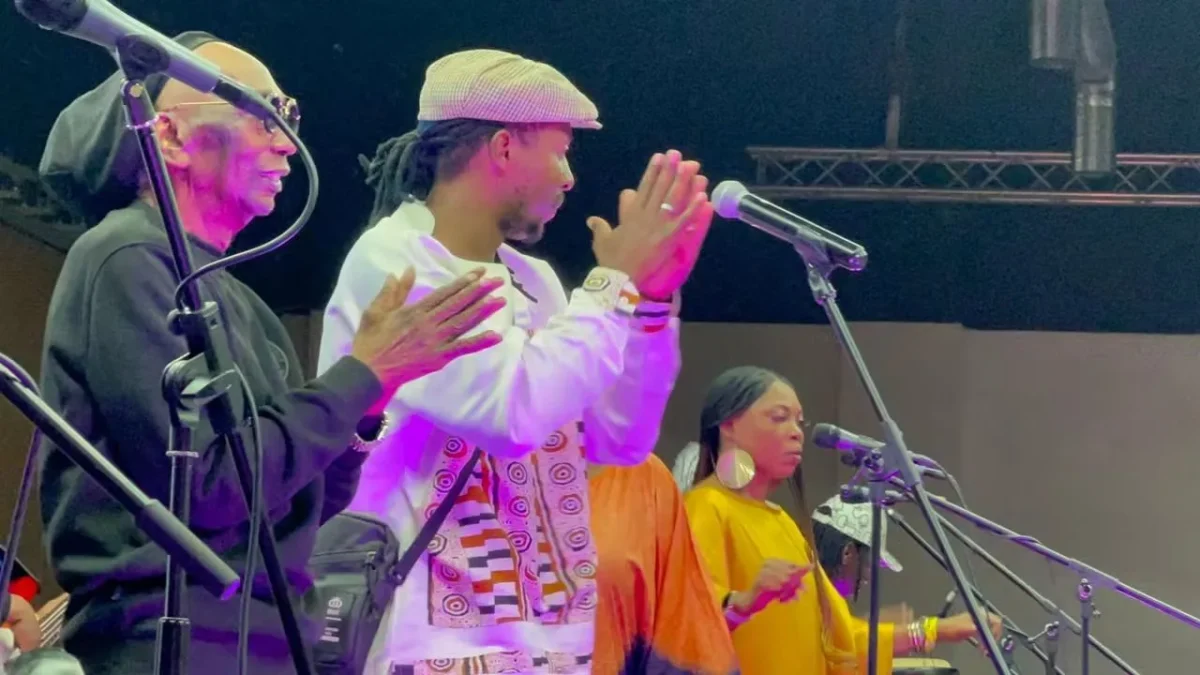
Harare-Zimbabweans love their music.They sing it in taxis, blast it from speakers at weddings, dance to it at shows and pass it from parents to children as part of a cultural inheritance that has survived generations.
But beneath the rhythm is a complicated question that the country’s entertainment industry can no longer afford to avoid: who has the right to use Zimbabwean music, and who should benefit when that music makes money?.That question has been thrust into the spotlight by a series of disputes involving some of the country’s biggest musical names.
The latest controversy involving Chimurenga music legend Thomas “Mukanya” Mapfumo and his nephew Kurai Makore has gone beyond a family disagreement. Mapfumo’s Chimurenga Music Company issued a cease and desist notice warning Makore against performing, recording, streaming or commercially exploiting works from Mapfumo’s catalogue without authorisation.
The controversy became even more heated after reports suggested that Makore had been presented as a possible heir or successor to the veteran musician. Mapfumo rejected that characterisation and made it clear that a family relationship should not be confused with ownership of an artistic catalogue.
That distinction is at the heart of Zimbabwe’s copyright problem.For decades, music has been treated largely as a shared cultural experience. A popular song becomes so deeply embedded in society that people begin to feel that everybody owns a piece of it.
But cultural ownership and legal ownership are not necessarily the same thing.A song may be regarded as part of Zimbabwe’s national musical heritage while particular rights remain attached to its composer, publisher, producer, performer or other rights holders.That is where many misunderstandings begin.
The same debate has surfaced around Alick Macheso and performances of his music by other bands, including Intotal Band.Intotal has built a following by bringing the music of established Zimbabwean musicians to contemporary audiences. Its Legends Night concept has demonstrated just how powerful nostalgia can be, with younger performers breathing new life into songs associated with some of the country’s most celebrated musicians.
There is nothing inherently wrong with one generation performing the music of another.In fact, it can be one of the most effective ways of preserving musical heritage.The problem arises when questions of permission, licensing, royalties and commercial use are not clearly understood.
A band may view its performance as a tribute.The audience may see it as entertainment.The original musician may see a commercial exploitation of his intellectual property.All three perspectives can exist at the same time.This is why Zimbabwe needs to move away from viewing copyright disputes purely through the personalities involved.
When a musician is warned against performing certain songs, social media often erupts.Fans immediately choose sides.Some accuse the copyright owner of trying to suppress younger musicians. Others argue that performers who use another artist’s material without proper authorisation are taking advantage of somebody else’s creativity.
The loudest voices are often driven by emotion rather than an understanding of copyright.A musician being stopped from performing a song does not necessarily mean that the musician has been “banned from music”.Likewise, a copyright holder defending a catalogue does not automatically mean that the artist is hostile to younger performers.
The real issue is whether the appropriate rights have been respected.Zimbabwe’s Copyright and Neighbouring Rights Act provides the legal framework for protecting copyright and related rights, including rights connected to musical works, performances and sound recordings.Yet having legislation on the books is only one part of the equation.The other is ensuring that the people affected by that legislation understand it.
This is where the Zimbabwe Music Rights Association, ZIMURA, finds itself under increasing pressure to demonstrate that copyright education is reaching beyond the traditional circles of registered rights holders.It would be inaccurate to suggest that ZIMURA has never conducted awareness programmes. The organisation has undertaken copyright awareness activities, including initiatives aimed at music creators.
The bigger question, however, is whether awareness is sufficiently broad, continuous and practical across Zimbabwe’s music ecosystem.A young musician in Mutare should be able to understand copyright without travelling to Harare.A band performing in Bulawayo should know what permissions and licences may be required before putting another artist’s catalogue into a commercial show.A promoter organising a concert in Gweru should understand the responsibilities attached to publicly using protected music.A DJ, wedding entertainer, club owner, church group and community event organiser should not have to learn about copyright only after receiving a demand for payment or a legal warning.Copyright education should happen before the dispute.That is the missing conversation.
There have also been disputes over ZIMURA’s licensing fees, demonstrating that copyright administration itself can become contentious. In 2025, controversy surrounded a proposed US$150 licence fee for live bands, with the National Arts Council directing that the tariff be suspended.Such disputes show why communication between rights administrators and the creative community is essential.Artists need to understand why they are being charged.Promoters need to understand what they are paying for.Rights holders need confidence that money collected on their behalf is properly accounted for.And the public needs to understand why copyright exists in the first place.
For musicians, copyright is not simply a technical legal concept.It can determine whether years of songwriting, recording and performing translate into income.A musician can spend months creating a song that becomes popular and then discover that its value is being generated in places and ways the artist never anticipated.
Today, a song can move from a recording studio to YouTube, TikTok, Facebook or another digital platform within minutes. A performance can be recorded by an audience member and uploaded before the artist even knows it happened.The digital age has therefore made copyright education more urgent, not less.Zimbabwe’s music industry is also entering a period in which the distinction between a tribute, a cover, a commercial performance and unauthorised exploitation will increasingly have to be understood.
That understanding cannot be left to musicians alone.Fans are part of the equation.The public has enormous influence over how copyright disputes unfold. When thousands of fans defend or condemn an artist online, they can turn a legal disagreement into a reputational war.But popularity cannot determine ownership.A song does not become ownerless because millions of people know it.Nor does performing a song repeatedly automatically transfer its copyright to the performer.
What Zimbabwe needs is a mature copyright culture in which artistic freedom and intellectual-property rights can coexist.The country should be conducting regular copyright clinics in all provinces, particularly in areas where musicians and emerging bands operate outside the traditional entertainment centres.The information should be simple, practical and available in languages that ordinary musicians understand.
Creators should know how to register and document their work, understand contracts, distinguish between different rights and know where to seek help when another party uses their material.Promoters and performers should likewise understand their responsibilities before an event takes place.
Most importantly, the system should not become visible only when somebody is threatened with sanctions.There is a lesson in the Mapfumo-Makore dispute.There is another in the Macheso-Intotal conversation.Neither should be dismissed as celebrity drama.
They are symptoms of an industry that has grown enormously while its understanding of intellectual property rights has struggled to keep pace.Zimbabwe has produced music that has travelled far beyond its borders. The country has created songs that define generations, artists who have become cultural institutions and melodies that remain powerful decades after their release.That musical wealth deserves protection.But protection cannot mean shutting the door on younger performers.Equally, artistic tribute cannot mean ignoring the rights of those who created the music.
The answer lies somewhere between the two: education, transparency, licensing, respect and a copyright system that musicians can understand and trust.The next time a packed crowd erupts when a familiar classic begins to play, the audience will probably not think about copyright.They will simply dance.And perhaps that is how it should be.But somewhere behind the stage, someone must know whose song it is, who owns the rights, whether permission has been granted and whether the creator will benefit.Because in Zimbabwe’s music industry, the battle over the song may only begin after the music stops.
Comments
Be the first to comment.