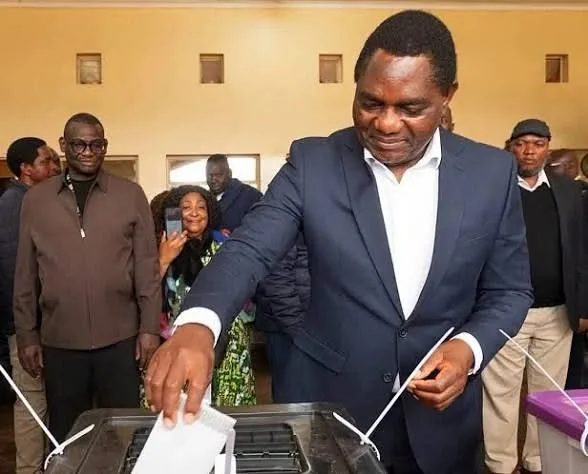
Zambia’s President Hakainde Hichilema has successfully secured re-election for a second five-year term, obtaining a significant 60% of the popular vote.
His principal opponent, Brian Mundubile, garnered 38% of the votes cast and has subsequently expressed disparagement towards the election outcomes, alleging electoral misconduct.
Zambia has, historically, exhibited a commendable tradition of peaceful transitions of power. Since the re-establishment of multiparty democracy in 1991, presidential handovers have been predominantly facilitated through the electoral process.
Nevertheless, controversy tends to be an inevitable aspect of electoral events. Much like in the realm soccer, not all participants agree with the officiating decisions of the referee, even in the contemporary context where we have Video Assistant Referee (VAR) to mitigate disputes.
In the 2021 elections, Hichilema received 2,810,777 votes compared to Mr. Lungu’s 1,814,201. Preemptively, Lungu raised allegations of electoral improprieties asserting that the electoral process was neither equitable nor transparent.
It is thus lamentable that those who do not emerge victorious frequently resort to allegations of rigging.
Locally the opposition has cultivated a narrative that portrays the ruling party as manipulative in electoral contexts. Ironically, they continue to participate which raises questions about their endgame. It suggests that they inadvertently perpetuate their own disenfranchisement.
What is their ultimate objective?
If defeat is interpreted as a consequence of electoral manipulation, does it not imply that ZANU PF could likewise accuse the opposition of running similar illicit advantages in urban constituencies where they traditionally find support?
Political entities ought to aspire towards structural competency so that, when electoral contests arise, they are adequately equipped to mobilize supporters, station election agents at each polling location, and allocate resources judiciously throughout contested territories.
During the recent campaigns for CAA3 I was on the ground and had a first hand experience of the potency of ZANU PF’s mobilisation power. In contrast the opposition failed to do the same and instead focused on social media.
Having previously engaged in elections as an independent candidate, I can speak to the necessity of robust preparation. During the 2016 by-election, it was the singular electoral event occurring at that time, affording the ruling party the opportunity to concentrate its resources exclusively in Norton.
Nonetheless, I was meticulously prepared. I enlisted students from @YARDzim2025 specializing in law, political science and media studies, to function as polling agents dispersed across all relevant areas.
Additionally, I collaborated with organizations like ZESN that specialize in electoral training to enhance our readiness to counteract potential irregularities. Thus, when I finally faced defeat in the 2023 elections, I refrained from alleging rigging, choosing instead to graciously concede, congratulating the victor and departing the stage with dignity.
One cannot advance a narrative of electoral manipulation while simultaneously contesting repeatedly in the same environment without first addressing underlying issues.
While elections invariably present challenges, such discrepancies do not equate to systemic rigging; often, they reflect a failure to address fundamental preparatory measures.
In Zambia, Mundubile and the NRPUP opted for what they termed a “strategic withdrawal” from campaigning in the Southern, Western, and North-Western Provinces. Its an approach reminiscent of Sekuru Chamisa’s infamous concept of strategic ambiguity which only served to confuse its own creators.
Under the strategic withdrawal tactic Mundubile and the Tonse Pamodzi Alliance effectively deemed the Southern Province politically inhospitable and ignored the area.
The outcome?
Across the Southern, Western, and North-Western regions, Mundubile garnered a mere 52,830 votes, starkly contrasted by Hichilema’s staggering 1.54 million.
Whom should we hold accountable for this disparity?
It raises the question: how can a serious political party abandon a province with 29 constituencies and expect to win? Following such shocking decisions to then allege electoral malfeasance is rather disingenuous.
This brings to mind a comparable situation in our own context.
In 2018, the MDC-A astonishingly functioned without Polling Agents at no less than 518 out of 10,985 Polling Stations itself an exercise in inefficacy. By 2023, matters had worsened with absent Polling Agents in approximately 2,500 out of 12,374 Polling Stations!
As a consequence, they found themselves without V11 forms for these stations, given that these crucial documents are issued to Agents who are present on-site.
Yet, paradoxically, the same party peddled allegations of rigging, despite lacking the essential corroborative information to support such inflammatory claims. This suggests that cries of foul play are merely politically expedient. Otherwise, when they enjoy success, it’s all fair play.
This tendency by opposition parties to allege electoral fraud after defeat reflects a deficit of political responsibility. Instead of undertaking internal introspection and strengthening organizational capacity, leaders resort to delegitimizing the electoral process.
The experiences of Brian Mundubile in Zambia’s 2026 elections and Nelson Chamisa in Zimbabwe’s 2018 and 2023 elections illustrate this pattern.
Both cited irregularities and an uneven playing field, yet both overlooked their weak structures and limited geographic reach.
For democracy to deepen, opposition parties must move beyond blanket allegations and embrace accountability. Credible contestation requires evidence-based challenges, strategic rebuilding, and a commitment to competing in every constituency.
Only through responsibility can opposition parties offer voters a viable alternative and strengthen democratic governance
Comments
Be the first to comment.