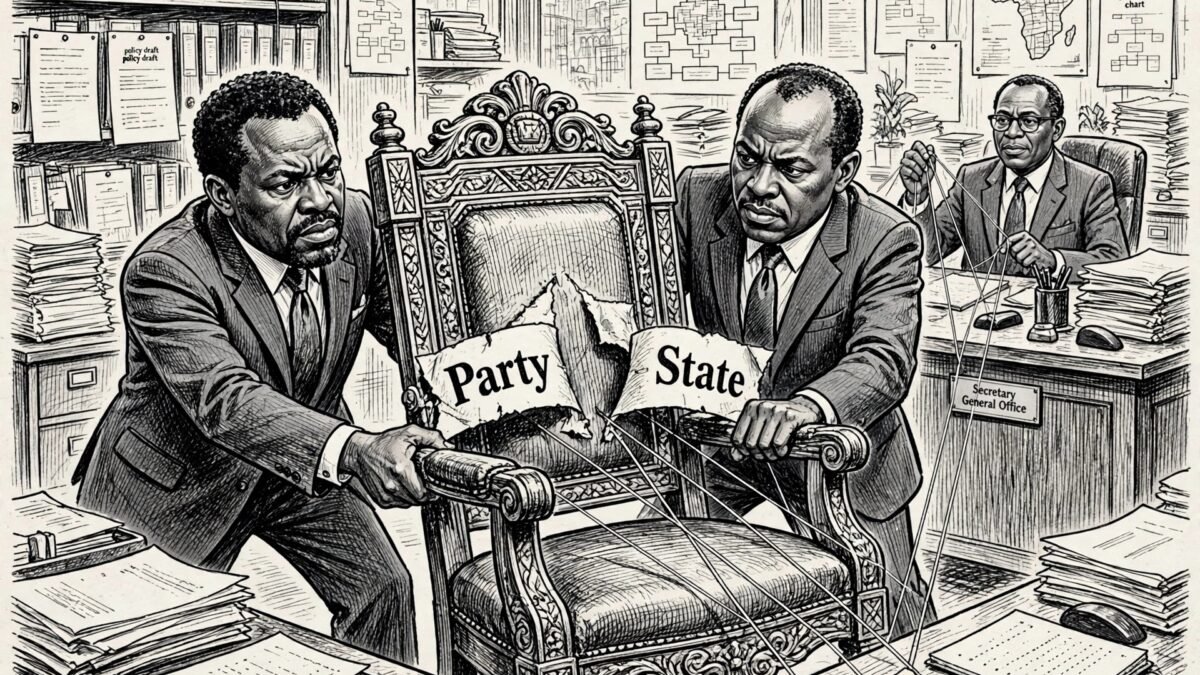
Within the architecture of liberation movements turned ruling parties, Constitutions are never mere administrative instruments; they are the scaffolding of power itself.
What appears as a dry exercise in legal alignment can often conceal a far more consequential struggle over who commands the State, and who commands the Party that commands the State.
The draft proposals for the amendment of the ZANU PF Constitution, by the Party’s Secretary for Legal Affairs, must be read in this light.
On its face, the document purports to align the Party’s supreme law with the Constitution of Zimbabwe Act No. 6 of 2026.
In substance, however, it introduced a doctrinal rupture that strikes at the very heart of ZANU PF’s political tradition since 1963: the indivisibility of the Party Presidency and the State Presidency.
For decades, the principle has been axiomatic: the President and First Secretary of ZANU PF is, ipso facto, the Party’s sole candidate for national presidential elections. The draft now seeks to sever that umbilical cord.
Legal Skullduggerry
The ZANU-PF Constitution has ALWAYS said the person elected as Party President at Congress automatically becomes the Party’s sole candidate for the State Presidential election.
What the draft proposes in 2.1 (a): is that “an elected President may not automatically become the State Presidential Candidate;
(b) If the Party President is not a Candidate for State elections, the Provincial Coordinating Committees sitting as Electoral Colleges shall nominate a State Presidential Candidate endorsed by Central Committee.
That is a constitutional coup.
It separates the two offices and for the first time in ZANU-PF history, you can be President of the Party but NOT President of Zimbabwe. And you can be President of Zimbabwe without being President of the Party.
That creates a centre of power ABOVE the State President. Combined with Section 3.1 (Supremacy of the Party), it says: The Party is the principal authority over Government.
The President, VPs, Ministers, MPs must obey party ideology/resolutions.
(c) “Any of those office-bearers who acts contrary to Party policy is subject to the Party’s Disciplinary Procedures.”
The explicit translation of that is: A sitting State President can now be disciplined, recalled, or fired by the Party President and Central Committee.
Even more corrosive, as Secretary for Legal Affairs, he tabled this without the knowledge or approval of the First Secretary (President Mnangagwa) and Secretary General Mudenda.
- Secondly it directly contradicts Act No. 6 of 2026 which was meant to align the Party Constitution to extend terms to 2030. The draft does the opposite as it creates a legal mechanism to remove ED as State President while remaining Party President, or to have someone else nominated as State President even if ED is still Party President.
This is treasonous because it gives the Party, controlled by a few PCCs, the power to recall a sitting President elected by Parliament under the new Constitution.
SECTION 7 – The Administration Directorate and Director General
This is another power grab.
Part of it reads “It is proposed to establish an Administration Directorate as part of the principal organs of the Party… operates under the direction of the Secretary General; headed by a Director-General…”
The Problems are immediately clear. The move (a) elevates a bureaucracy to a Principal Organ. As it is, Principal Organs are Politburo, Central Committee, Congress. Now a secretariat of employees also becomes equal to them.
Secondly, it transfers Party power from the President to the Secretary General. Under the current Constitution party administration is under the President who is also the First Secretary.
However, under this proposal
- 7.1(a) – operates under SG
- 7.2(b) – DG chairs recruitment of all staff, except Directors who are recruited by a Committee headed by the SG
- 7.2(a) – DG provides secretariat to ALL Principal Organs – meaning he controls agendas, minutes, records, information flow.
The SG becomes the de facto Executive Prime Minister of the Party, while the President is reduced to a ceremonial figure who only gets a casting vote.
c) It also creates a Deep State.
The DG is not elected at Congress but is an employee appointed by the SG. Yet he will supervise all Department Directors. This is how you build a permanent factional machine that survives Congresses.
Thus the proposed changes in Section 6 gives the President a fake crown, while Section 7 takes away the real power, control of the Party machine and gives it to the Secretary General.
Conclusion
To be fair, every ruling party that makes a major national constitutional amendment must realign its own charter. Act No. 6 of 2026, by introducing a parliamentary mode of electing a State President, necessarily forces ZANU PF to clarify the relationship between its internal electoral processes and the new national process. In that narrow sense, a draft was needed.
However, the question is never whether to align, but how to align.
A faithful alignment would have reinforced the axiomatic principle: that under the new parliamentary system, the President and First Secretary elected at Congress shall be the Party’s sole nominee to be elected as State President by Parliament.
It would have closed loopholes. Instead, the draft opens them. It introduces conditionality where there was certainty.
The Constitution should unify command, clarify accountability, and prevent the emergence of competing sovereignties. This draft does the opposite.
By severing the Party Presidency from the State candidacy, by asserting that a State President can be subjected to party disciplinary procedures, and by re-engineering the administrative levers of the Party to operate under the Secretary General and an unelected Director-General, it does not align the Party to the State Constitution. It aligns the State to a new Party oligarchy.
It creates, for the first time since 1963, the legal architecture for two centres of power: a Party President who controls the Party and can discipline the Government, and a State President who governs at the pleasure of Provincial Electoral Colleges.
History teaches that where Party and State are made to compete, the Party bureaucracy always wins.
If the aborting of the Politburo was to prevent this draft from being railroaded, then it was an act of institutional self-preservation. The task now is not to personalize the debate around Hon. Ziyambi, but to return to first principles.
Any amendment must restore the indivisibility of the two Presidencies, reaffirm that the Party’s supremacy is exercised through its President and First Secretary, not against him, and ensure that administration remains a service to elected leadership, not a principal organ above it.

Comments
Be the first to comment.